MARTIN GENDELL'S PORTFOLIO
Hall Effect Ion Thruster


Hall Effect Ion thrusters are an electric propulsion system used on all sorts of satellites; from 200kW thrusters used on telescopes and long-term space exploration missions to small sub 100W class systems used for CubeSats. The goal of my project is to use Ceramic 3D printing to simplify the design, reduce the cost, and create a modular and scalable hall thruster framework

How it works
A Hall Effect Thruster uses electromagnetic fields to capture and accelerate electrons generated by a Cathode into a neutral gas such as Krypton, Argon, and Xenon. This knocks out one of their electrons, turning them into positive ions. These ions are then repelled from the positively charged baseplate, accelerating away from the thruster and generating thrust. One of the biggest challenges with this design is manufacturing the complex ceramic discharge channel (CDC) at the thruster's core, a problem I aim to solve by 3D printing it with a ceramic-resin composite.


Goals

Reduce size & power usage
The power constraints of the CubeSat allow for a maximum power allocation of less than 100W, very low for a Hall Thruster. Few thrusters exist at this scale, so this project will function as a testbed for power and size reduction.

Simplify Design
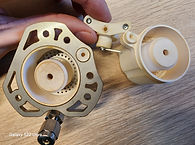
3D printing the ceramic discharge channel out of a ceramic-resin composite and integrating components into it will reduce part count by ~40%.
Integrate scaling & modularity
Using Parametric 3D Modeling I will create a fully adjustable thruster model where users can input variables such as electromagnet size, discharge channel diameter, and gas line dimensions, to customize their hall thruster

Design overview


3D Printed CDC
Integrated Fuel Lines
"Cold" Hollow Cathode
Electromagnetic Coils

Single part printed from resin-ceramic composite. Houses fuel lines and cathode to reduce parts. Heat resistant up to 300c.
Fuel lines and gas diffusion are built into the CDC, distributing fuel to the Hollow Cathode and Anode.
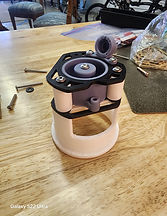
Coils are simulated in Simscale and optimized for best power to thrust ratio.
Innovative heater-less Cathode generates electrons and is integrated directly into the CDC


Process Pictures

.jpg)
.jpg)



.jpg)
.jpg)
.png)


Next Steps
Test the Hall Thruster in my custom Metal 3D printed Vacuum Chamber and collect Thrust, Specific impulse, and fuel consumption data.
